
Miniature Garage Loft Furnishings – Phase 5
Continued from: Miniature Garage Loft Furnishings – Phase 4
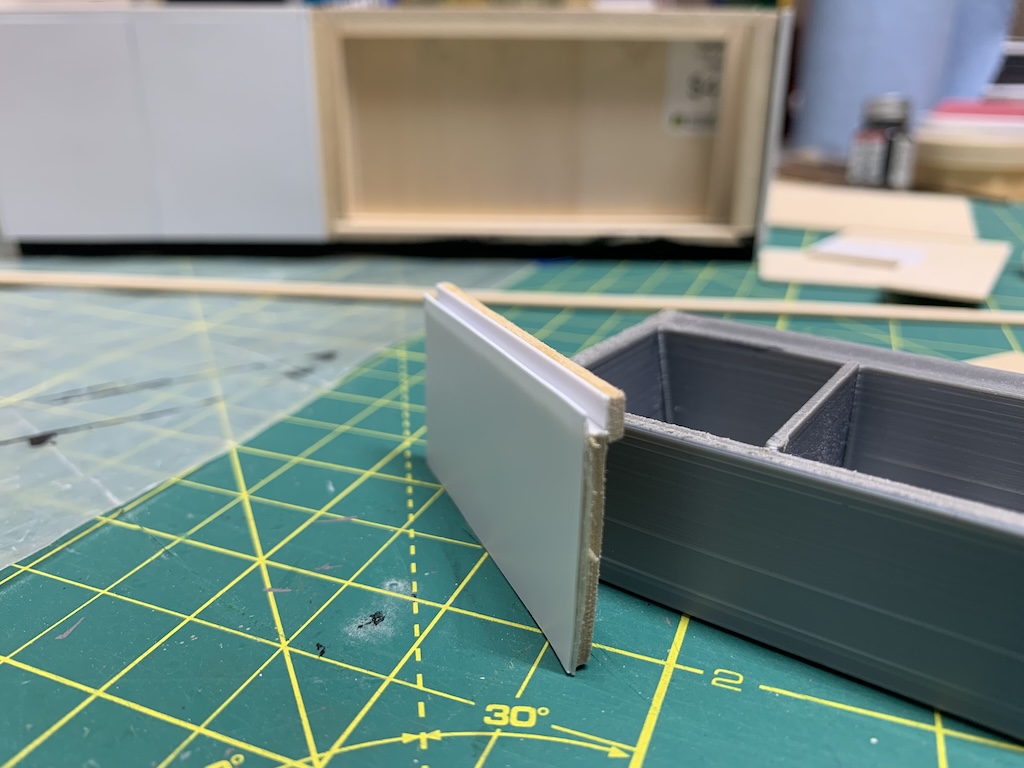
I thought this looked good and closely modeled the full-scale kitchen drawers.

Now came the hard part—figuring out how to make the three drawers fit the 2 and 5/8” height I had in the cabinet.
I pondered this for a while and then thought I could use my good friend algebra (I love math!). To make sure I accounted for the height of each piece, I drew a diagram and then out to the side added up the thickness of the polystyrene strips (0.015”) that would add to the height (the recess area is 0.125 or 1/18”). I set the height of the bottom two drawers as X and the top shorter drawer as Y.
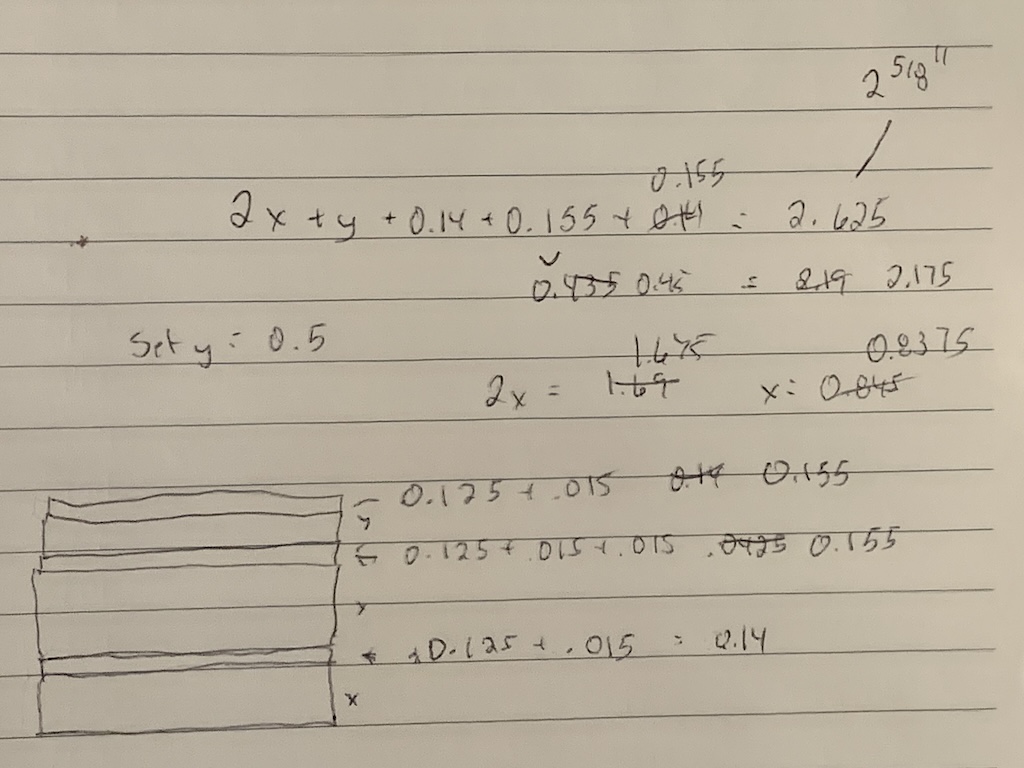
Recall I arbitrarily set the shorter drawer to a height of 0.5” based on our kitchen top drawers being 5.5” tall. This gave me an equation with a single variable. Solving for X gave me 0.8375” which converts to 26.8/32”. In full-scale that would be about a 10-inch-tall drawer. I checked ours and they were 11 inches. As they say, close enough for government work.
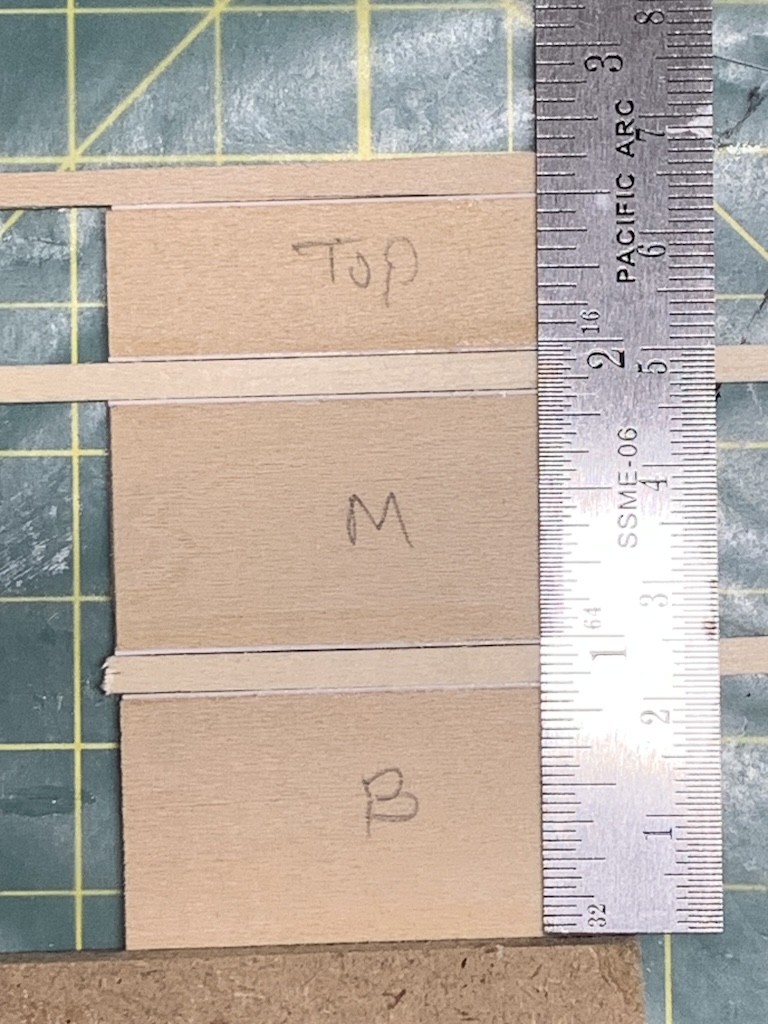
Using my metal ruler that has 1/32 divisions up to an inch, I cut two strips of basswood 1.75” long by 27/32” high and then a 1/2″ strip of basswood 1.75” long. I then glued 1/16” strips of polystyrene to the tops and bottoms of the three drawers. Between the drawers, I placed 1/8” strips of basswood to mimic the 1/8” polystyrene strip that would be glued to the back side of the drawers. When I laid my ruler down, it was just a smidge over 2 and 5/8”. If need be, I could sand down the bottom drawer to get rid of this smidgen and I doubted anyone would ever notice the difference.
The next step was to cut a single piece of 1/16” basswood to fit into the cabinet opening to which I would glue all nine of the drawers.
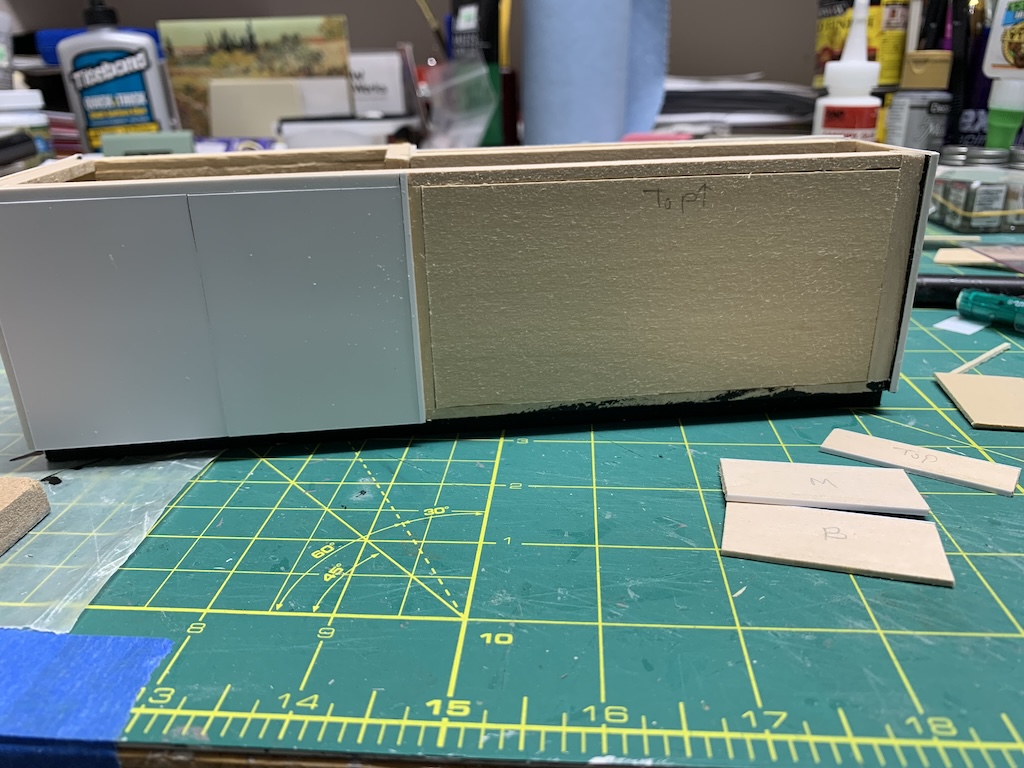
To ensure that all six larger drawers were the same height, I cut two lengths of 1/16” basswood and then cut three pieces 1.75” from each but when I laid them onto the cabinet, they extended beyond the inset space.
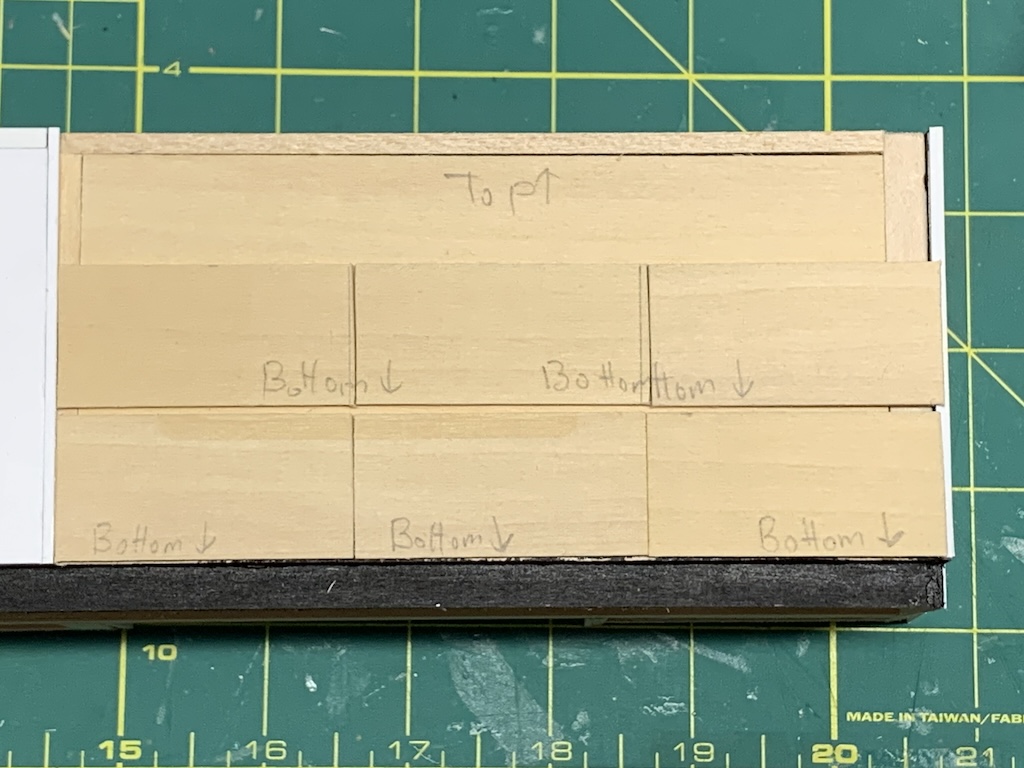
Remeasuring them I saw they were slightly longer than the desired length. I could only surmise that my pencil mark was slightly too long. I then clamped all six together and sanded them. When I replaced them, they just fit.
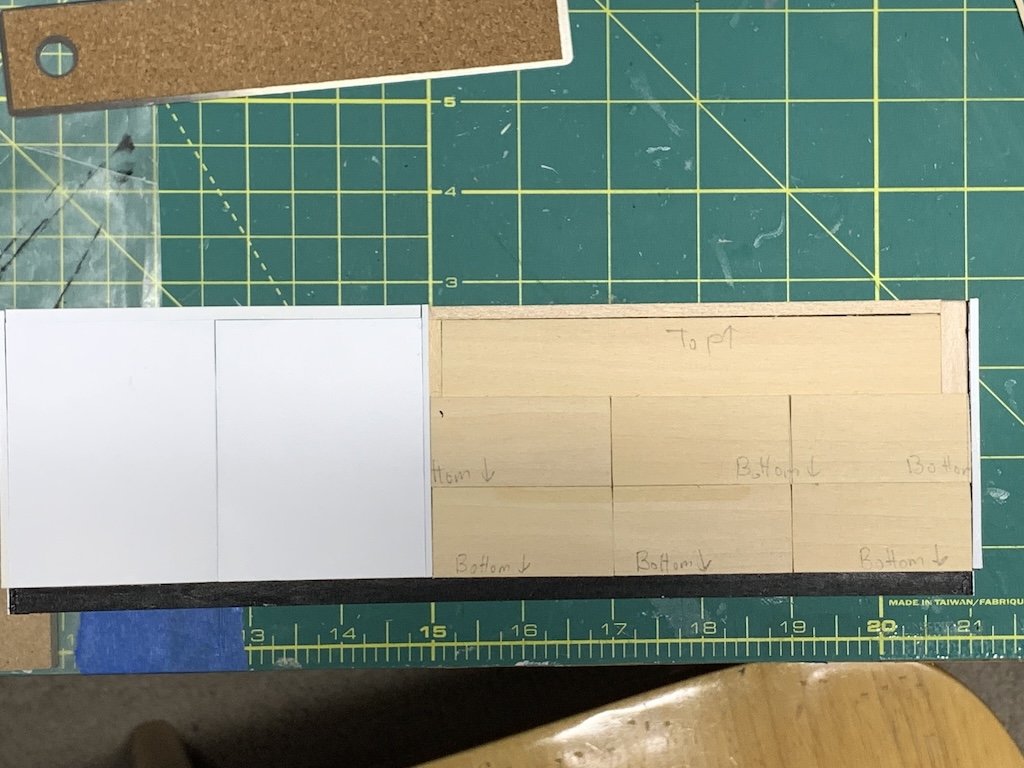
The top three drawers I cut the 1.75” length from a 1/2″ basswood strip and laid them down with the other six drawers.
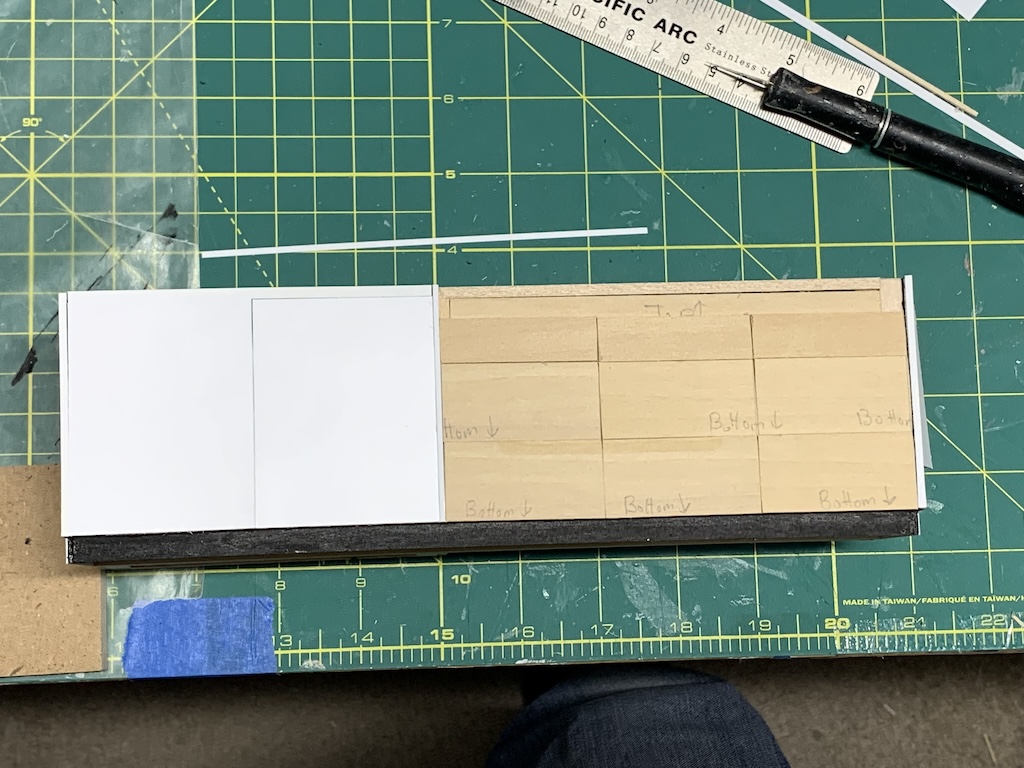
When I measured the distance remaining from the top drawers to the top of the cabinet, I just had 3/8” which only allowed for the three 1/8” polystyrene strips that would provide the recess at the top of the drawer and not the 1/16” strip that would be on top of the drawer. Pondering this, I knew my algebra was correct but then I remembered I had rounded the 26.8/32” up to 27/32” because I knew I could not accurately measure a fraction of a 1/32”. Turns out 0.4/32”, the sum of two drawers cut is 0.0125” which is just about the thickness of the polystyrene (0.015”). And I knew I was just eyeballing the 27/32” with my ruler so the cuts could be slightly too tall.
I got out my nice calipers and measured the height of one of the larger drawers and sure enough, it was 0.864” rather than the 0.8375” I had calculated meaning I would need to sand them down slightly.
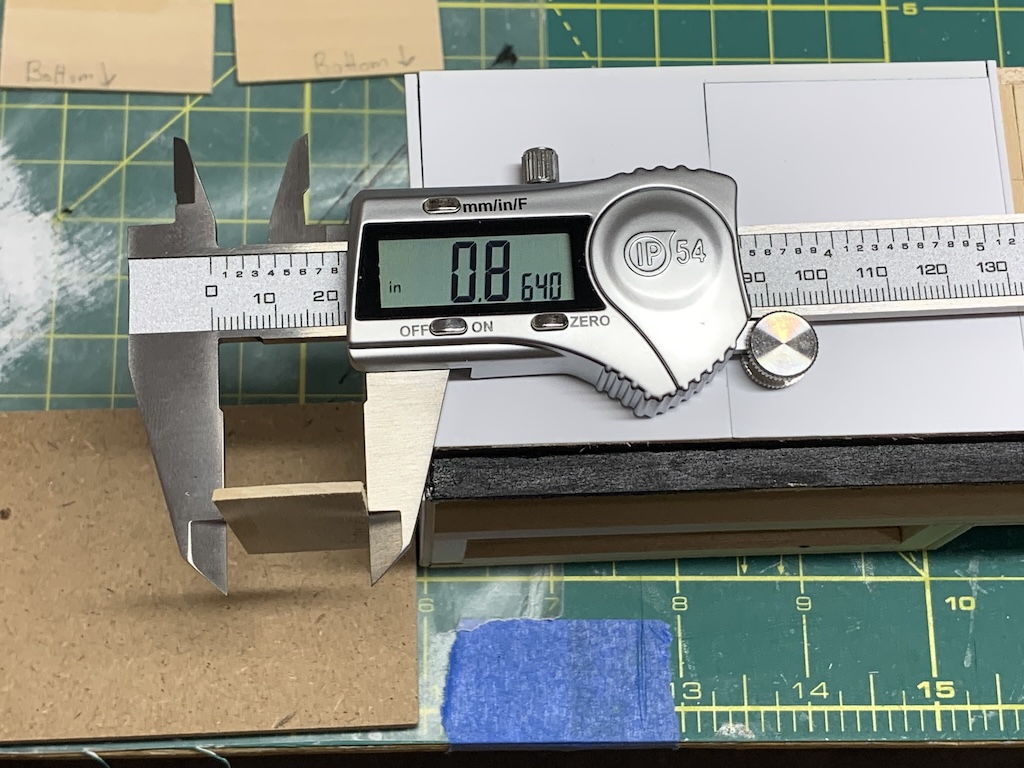
I clamped all six drawers together and then sanded them down to 0.840” as measured by my calipers (I didn’t want to go too far). I next glued the 1/16” polystyrene strip to the top of all nine drawers. To check if everything would now fit, I stacked the left side drawers on the cabinet with a 1/8” strip of polystyrene at the top of each drawer.
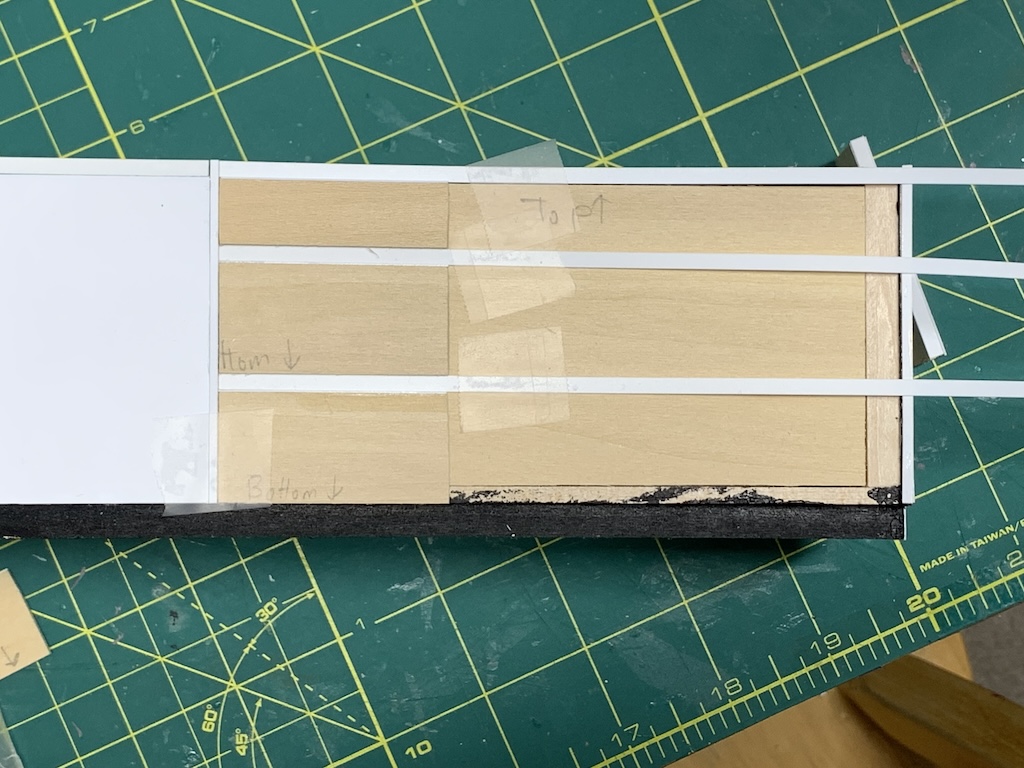
They just fit!
Although this did not allow a 1/16” strip of polystyrene at the bottom of the middle and top drawers that I had planned, I figured I could paint the bottoms white as only an ant looking up from the floor could notice a slight difference between the white paint and the white polystyrene.
With all nine of my drawers the correct size, I could now apply the polystyrene sheet to the front of each. Recall that I wanted to allow the polystyrene to stick up above the top of the drawer by 1/16” to allow for the finger pull. So, I first applied the carpet tape to the basswood drawer. Then using my right-angle square, I placed a 1/16” square piece of basswood down and then pressed my drawer up against it.
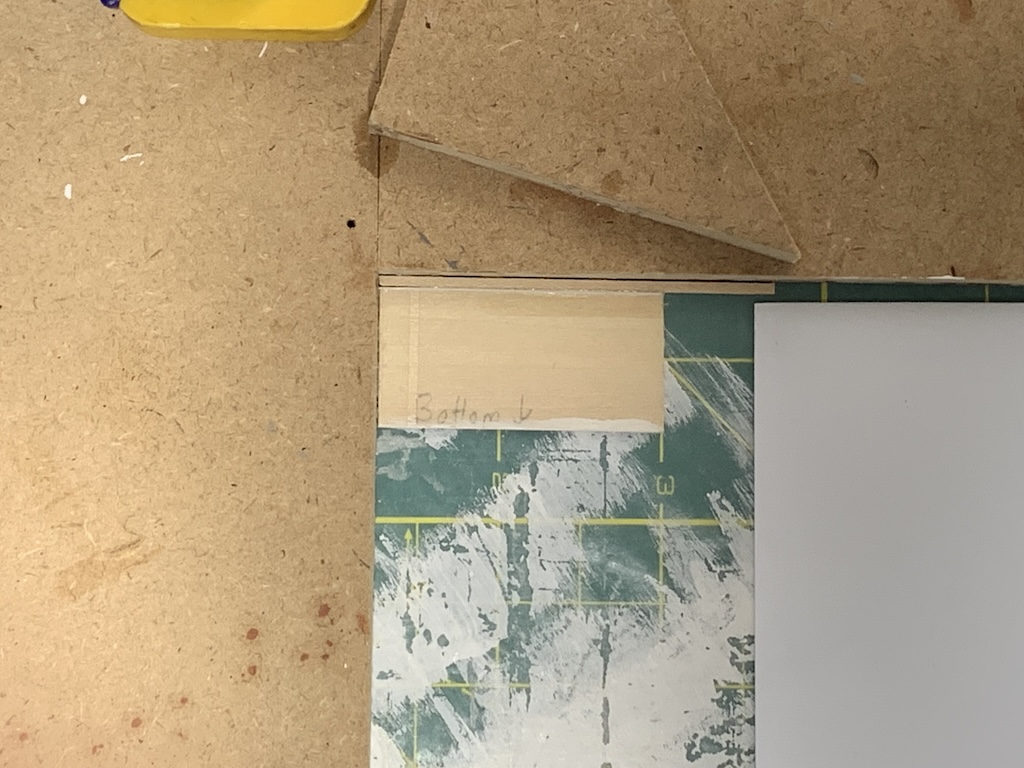
But before I attempted the first drawer, I realized while pressing the opaque white polystyrene sheet onto the drawer, I could not tell if the drawer shifted or moved so I added another piece of basswood to hold the drawer in place and weighed it down so it would not move.
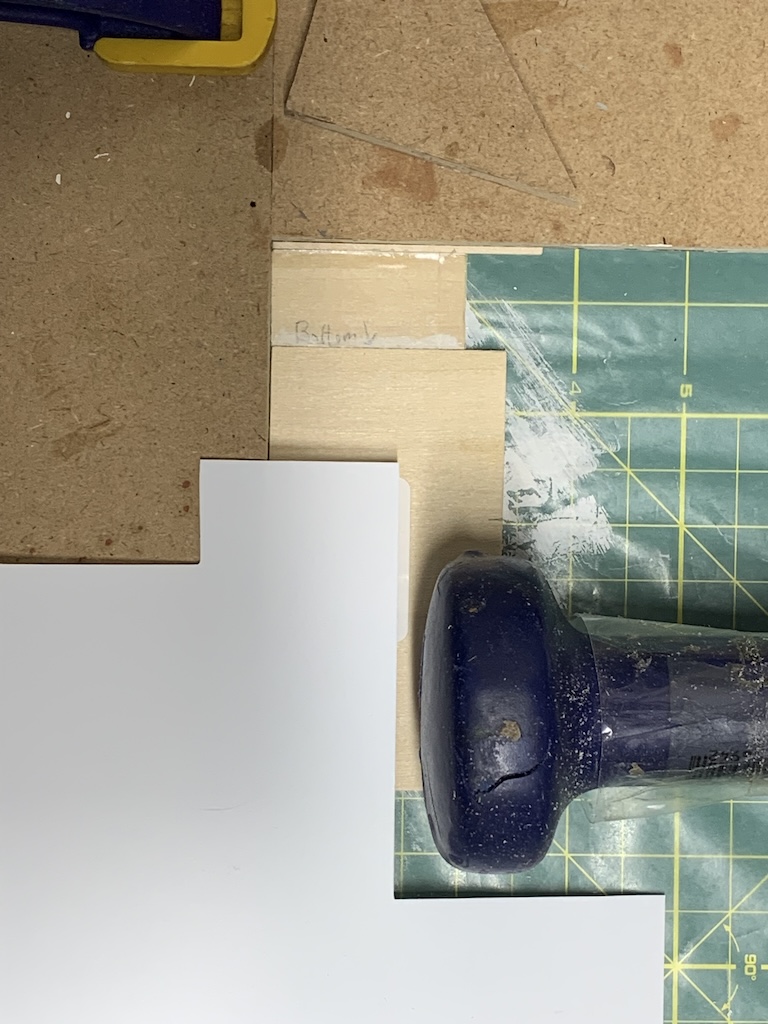
This approach worked great!
With the bottom three drawers now finished, I could glue them in place.
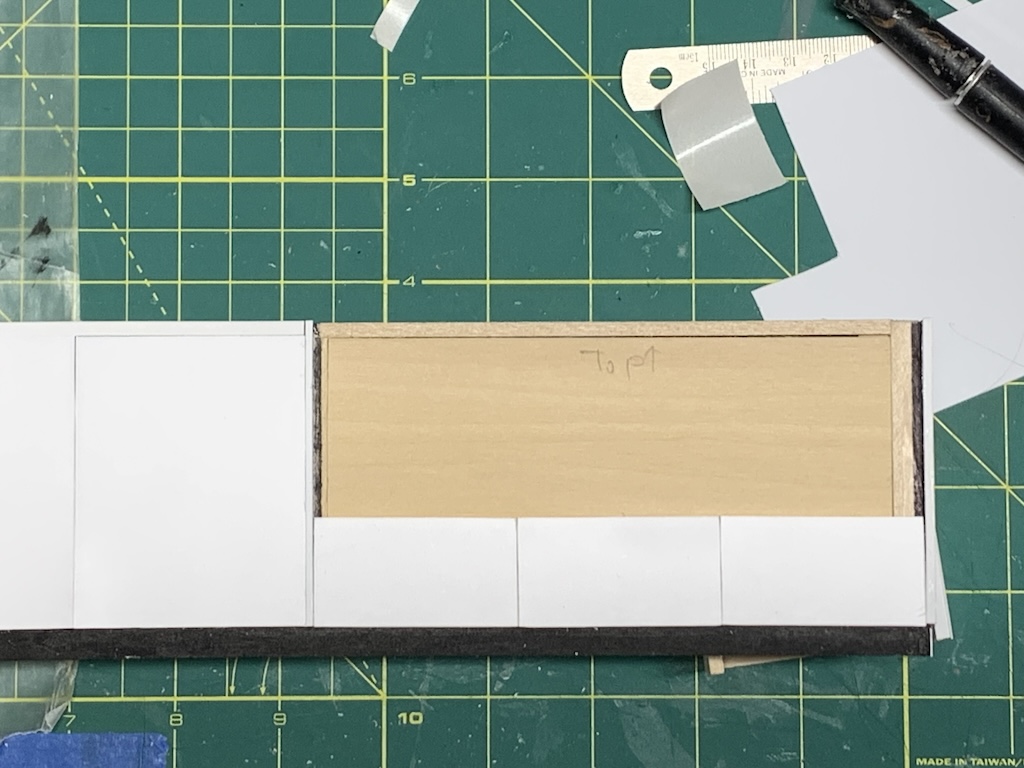
Once dry, I could then glue in place the 1/8” polystyrene strip at the top of the drawers to create the finger recess on each drawer.
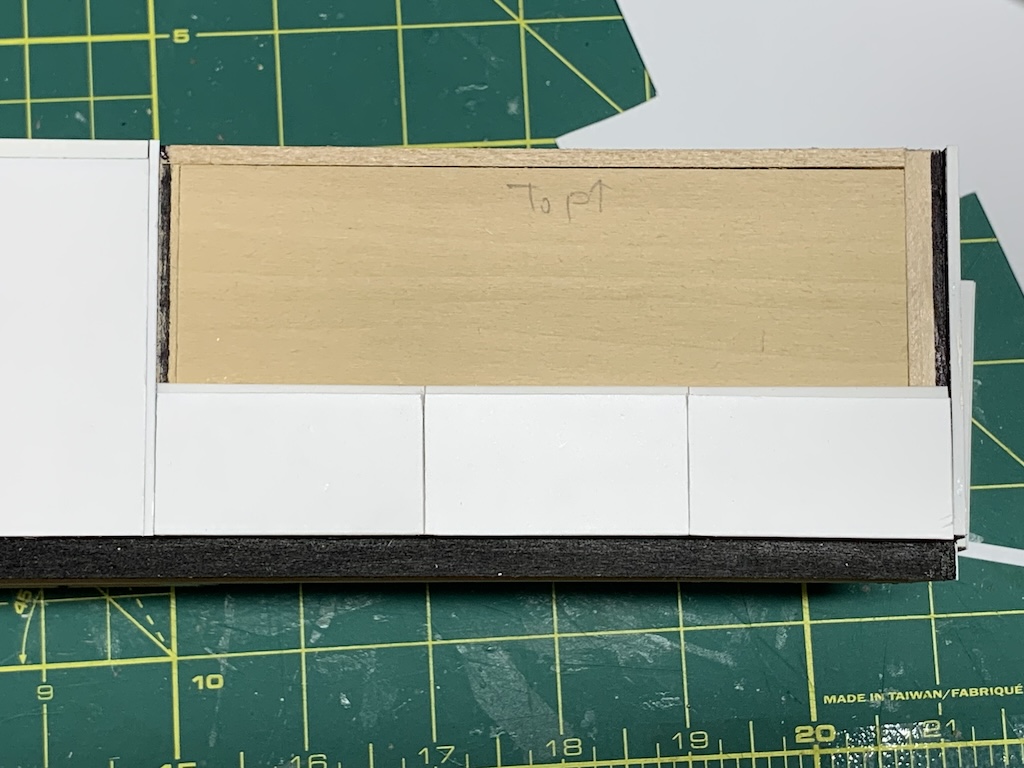
Using the same approach, I proceeded to add the polystyrene sheet to the other six drawer fronts, gluing the drawers in place, and spacing them apart with the 1/8” polystyrene strip to create the recessed area.
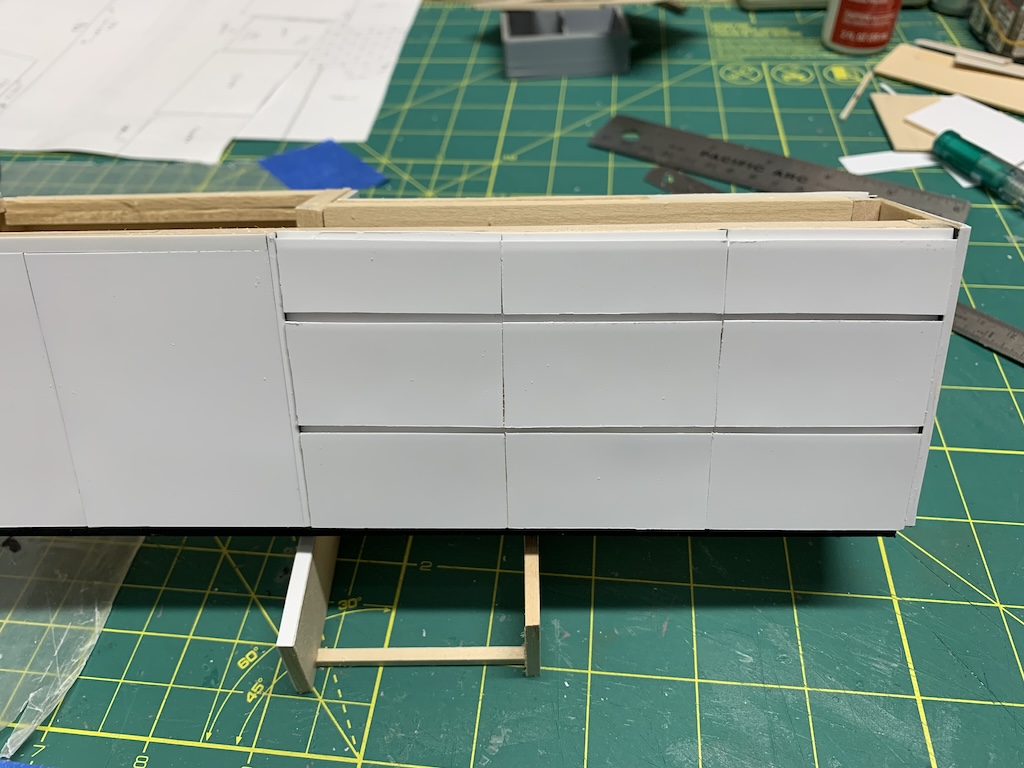
With all nine drawers attached to the cabinet, I thought it modeled the full-scale kitchen drawers very nicely.
Now I could figure out the countertop for this cabinet.
To be continued…
Categories


Amazing, David! Your preciseness is most impressive. You did have me pondering about the ant. What size would the ant be in the garage loft, if it was to scale? Ha ha. You don’t have to answer, but I am sure you could figure it out mathematically. 😄 Have a great Sunday!
Thanks Betty for your kind words! Hope you have a nice Sunday as well!